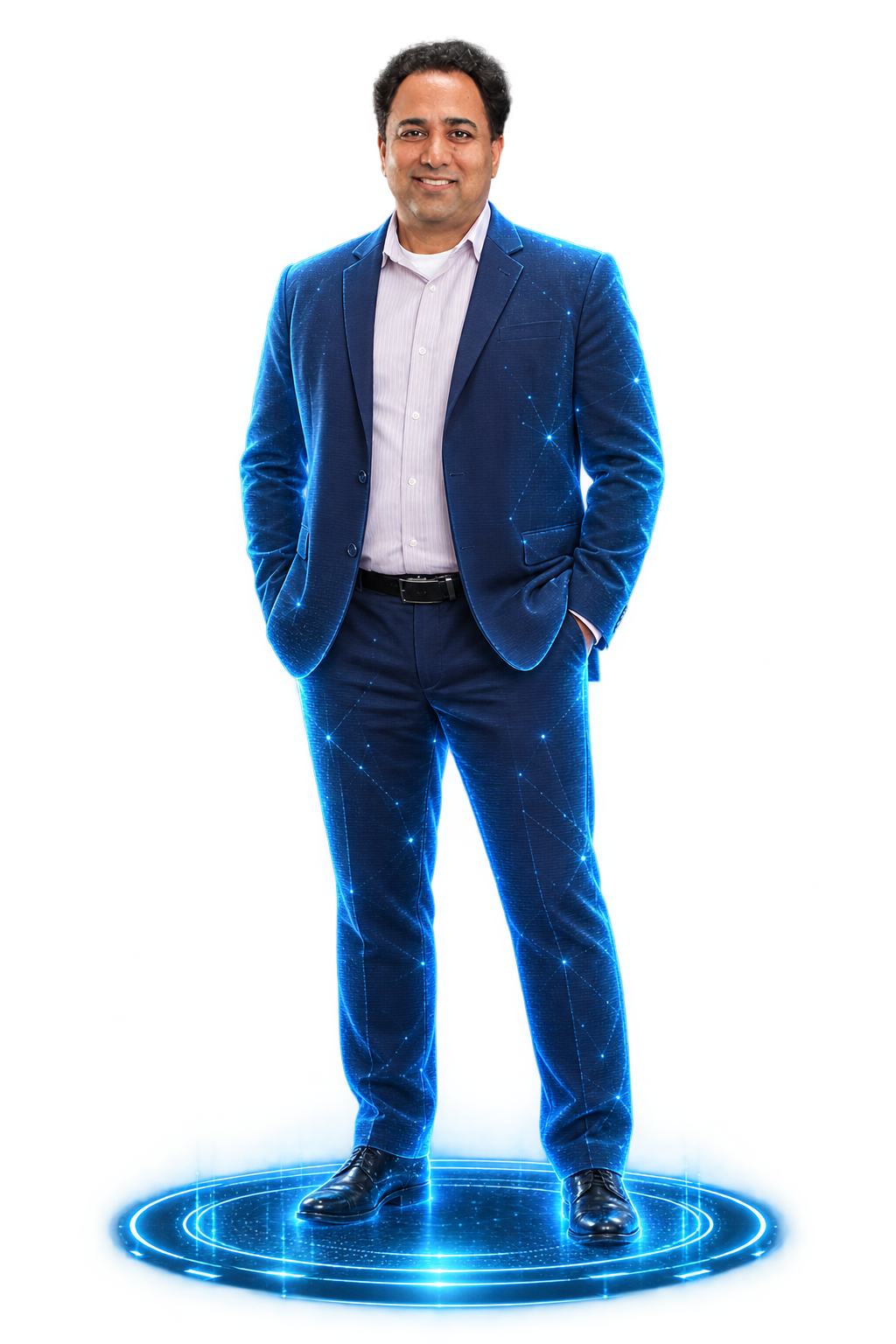
One question, five different ways of asking it.
Across more than three decades of professional experience, I have kept returning to a single problem in different settings: why organizations that know what to do so often fail to do it.
My professional career began in 1995 with federal systems integration. Working across different firms and international projects taught me how differently institutions approach the same problem, what professional discipline looks like under pressure, and which skills still transfer when the country, client, or technology changes. The titles and tools changed; the lesson did not. What holds at scale is the system underneath.
That work also put me on the road. Seeing how people elsewhere build, decide, and organize sparked the interest in travel that has since taken me to 67 countries. I founded NextGen Consulting, Inc. in 2006. Today, the firm builds governed AI for government and enterprise: systems where a machine can draft anything and a named person owns every consequential decision. A fuller position-by-position record belongs on LinkedIn; this site is about the ideas that connect the work.
What the private sector could not teach me, public service did.
What the private sector could not teach me, public service did. Over the last six years, Republican and Democratic governors of Maryland appointed me to three state commissions: consumer protection, economic development, and service and volunteerism. Two appointments received the advice and consent of the Maryland Senate. Since 2020, I have also served on the board of Disaster Services Corporation, SVDP-USA, contributing to the governance, partnerships, and organizational capacity behind long-term disaster recovery.
I took them for a selfish reason: it is very difficult to understand why public programs stall unless you have sat inside one while it was stalling. What I learned there ran against the grain of everything I had built. A company optimizes for execution. A public institution is optimizing for something harder: being answerable to people who did not choose to be involved. A good deal of the friction I would once have removed on sight turns out to be load-bearing.
That discomfort became a novel. The Continuity System asks what happens when a democracy is offered competence in exchange for uncertainty, and takes the trade. It is published by Rehman House Press, and it is the only one of these pursuits that lets me leave the question open instead of answering it.
I have undertaken four local campaigns in Howard County: three previous runs and the current fourth, as an independent candidate. What that has taught me is on the politics page: it is an argument about parties and process, not a platform.
Enough context to understand the work
This is a personal story, not a chronological résumé. The complete professional record is available on LinkedIn.
Three countries, and then one street
I have called three countries home: Pakistan, Kuwait, and the United States. Today home is Ellicott City, Maryland, where my wife and I are raising our three children, and where I have built a business, coached, volunteered and run for office in the same few square miles for twenty years.
The traveling is not separate from the rest. Sixty-seven countries so far, and every one of them is solving the same human problems in a different language and with different tools: how to keep people safe, how to school the young, how to give ordinary families a fair shot. Singapore taught me that competent institutions are the foundation of trust, not a luxury. Norway taught me to plant trees whose shade I will never sit in. Poland taught me what rebuilding actually costs.
I hold a Ph.D. in Management Information Systems. The rest is on the business, public service, politics, travel and writing pages.